
How to Find Funding and Investors for a Fashion Brand

Find the right capital before you start pitching the wrong investors.
Explore real funding sources, distinguish venture investors from grants and loans, and use a free tracker to build a qualified shortlist.
The best way to find funding for a fashion brand is to match the funding route to your actual business need. A clothing label financing its first production run may be better served by preorders or a small-business loan; a scalable fashion-tech platform may be a more natural candidate for venture capital. Start with your use of funds, unit economics and customer evidence, then research organizations whose stated focus matches your stage and business model.
Below are named investors, official programs and founder-facing platforms you can investigate today. They are research starting points, not endorsements, approved investment matches or assurances of open applications. Conditions change. Always check the linked source before applying.
Jump to the practical sections
Funding routes · 14 named resources · Investor fit · Free Excel tracker · Investor readiness
Choose your funding route before choosing an investor

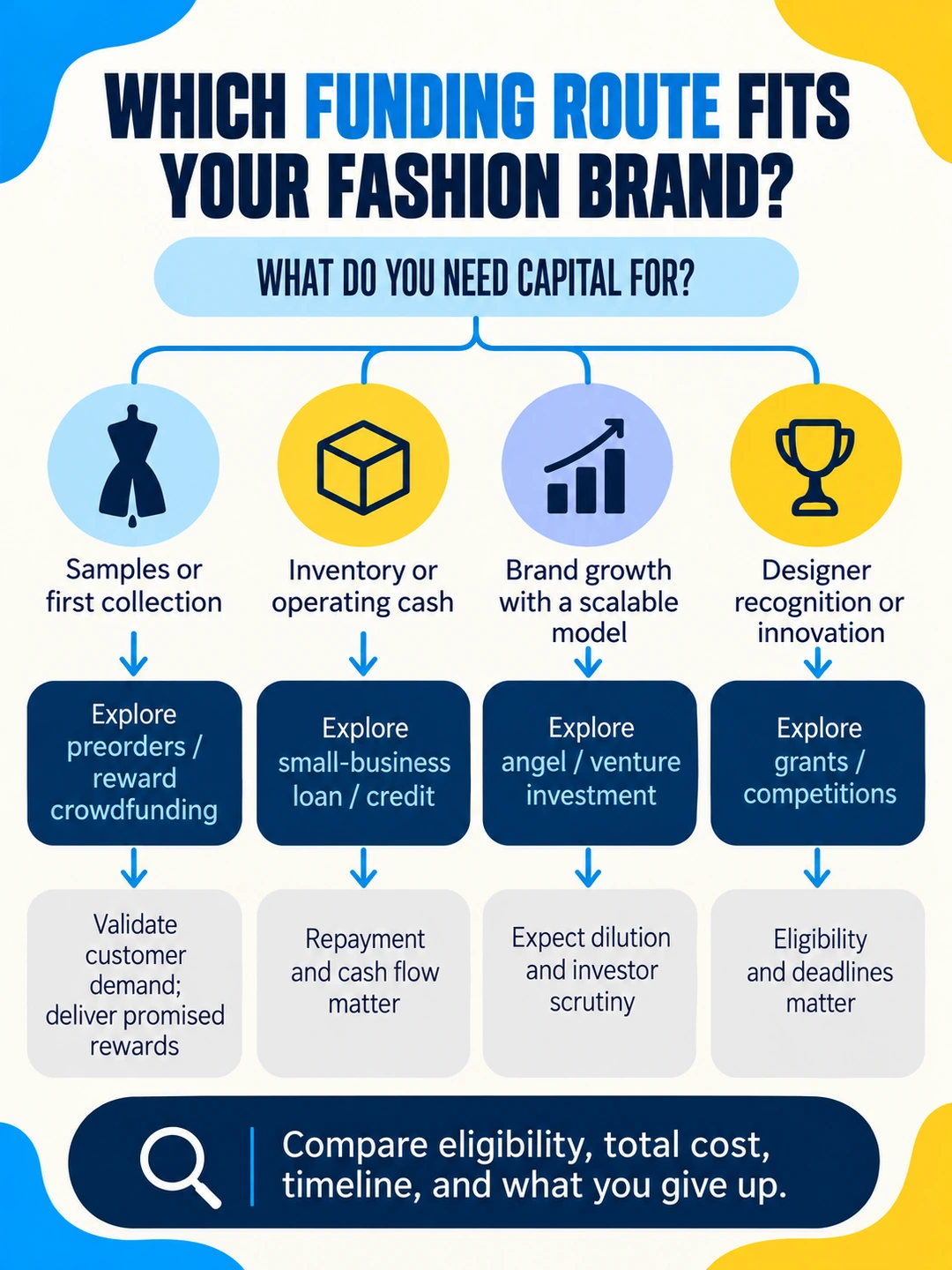
Fashion businesses need different kinds of capital at different moments. The immediate challenge may be paying for fabric, minimum order quantities, samples, inventory, a retail opening, or an expansion into new markets. Those needs do not automatically require selling a stake in the company.
Start with three questions: How much money do you need? What milestone will it finance? And how will the business repay it, fulfill a customer promise, or create enough future value for an investor?
For an early clothing line, the answer may be a modest manufacturing budget and evidence of preorder demand. For a technology-enabled resale platform, it may be a larger round tied to user growth, transaction economics and a differentiated technology model.
A practical comparison: rewards crowdfunding and preorders ask customers to support a product or collection; loans must be repaid; equity investors receive an ownership interest or other investment rights; and grants or awards depend on program rules, eligibility and selection. These are not interchangeable products.
| Funding route | Typical reason to investigate | Main trade-off |
|---|---|---|
| Preorders or reward crowdfunding | Prove demand and finance an initial collection | Manufacturing, delivery and fulfillment obligations |
| Small-business lending | Inventory, equipment or working capital | Repayment, costs and lender requirements |
| Angel or venture equity | A business with a credible scale and return story | Dilution, investor rights and diligence |
| Award or grant programs | Eligible design, innovation or sustainability projects | Competitive selection and deadlines |
| Community investment crowdfunding | A business with traction and an engaged audience | Securities compliance, costs and campaign preparation |
The choice also depends on your margins. A product can have healthy gross margin on paper yet still face serious cash pressure when factories require deposits months before customers pay. Build a basic cash-flow forecast before setting a fundraising target.
14 named fashion funding and investor resources worth researching
The following organizations are grouped by what they actually provide. The first group contains investment firms; later groups include a research directory, crowdfunding services, loans and competitive fashion programs. Not every organization will be suitable for, or accepting inquiries from, your company.
Investment firms

Forerunner describes itself as an early-stage venture investor. Its portfolio includes consumer businesses such as Warby Parker and Glossier; a conventional small apparel label should examine whether its growth potential matches the firm’s category-building thesis.
Look for: exceptional consumer insight and a defensible growth thesis.
Imaginary focuses on consumer companies and selected enabling technologies. Its luxury-commerce and brand-building background makes it worth researching for ambitious fashion businesses, but this does not establish an open pitch route.
Look for: brand differentiation, a sizable market and credible expansion potential.
Felix describes its focus as the intersection of technology and creativity. Its published investments include fashion, retail and consumer names; a fashion-tech, commerce or digitally distinctive consumer business may be more aligned than a local boutique.
Look for: a scalable model and a compelling technology or creativity angle.
Investor research
OpenVC maintains a searchable fashion-related investor list. Use it to discover candidates, then check each firm’s own current thesis, geography, stage and preferred application process. A directory listing is not confirmation that a firm will invest.
Look for: filters that narrow a long list into a viable shortlist.
Crowdfunding and community capital
Kickstarter offers a fashion-specific route for independent designers to introduce collections to backers. Supporters pledge toward rewards; Kickstarter does not receive equity in the creator’s company. Founders remain responsible for successful fulfillment.
Look for: a compelling, demonstrable product and realistic delivery budget.
Republic offers fundraising routes for eligible companies that want to involve investors, including their communities. Its offerings have selection criteria, legal structures and costs; it is not a grant program or simple pre-order website.
Look for: existing community interest and readiness for securities-related obligations.
Wefunder is a marketplace for eligible startups and community investment rounds. A fashion business should investigate issuer qualification, fees, securities requirements and realistic campaign promotion needs.
Look for: a recognizable customer base and a coherent business growth case.
Small-business lending
The SBA program supports eligible U.S. small businesses through intermediaries, with loans of up to $50,000 for uses that can include inventory and working capital. Credit decisions and terms come from participating intermediary lenders.
Look for: a defined funding amount, intended use and repayment ability.
Kiva describes U.S. small-business loans that are funded through community lending, subject to its eligibility and fundraising process. It is debt, not a donation or angel investment, even when the interest rate is zero.
Look for: eligibility and an engaged support network willing to lend.
Fashion awards and programs
The CFDA/Vogue Fashion Fund supports emerging American fashion designers through selection and mentorship. The 2026 application closed in April; consult the official program for future cycles and eligibility instead of treating this as an open application.
Look for: designer-specific eligibility and the next announced cycle.
This program has supported circular-fashion innovations, such as solutions involving resale, repair or materials. Check for an announced current cycle and the applicable rules; the published U.S. program information includes earlier dates.
Look for: a genuine circular-fashion solution and current application details.
CFDA and NYCEDC announced a 2026 initiative supporting eligible designers shifting or adding production in New York City and local manufacturers. Its July 2026 application deadline has passed; check for future rounds.
Look for: manufacturing location and program-specific eligibility.
CFDA announced a 2026 funding initiative for independent American designers advancing sustainable fashion. Award size, selection and deadlines are program-specific, so rely on the latest official announcement before pursuing it.
Look for: substantive sustainability innovation and verified program eligibility.
CFDA maintains a broader index of professional development and support programs. It is useful for finding category-relevant initiatives beyond one award, but is not itself an investor or an automatic source of money.
Look for: programs specifically matched to the company’s eligibility and work.
About the organization icons: these small site icons are loaded remotely from a favicon service and may change or disappear. They are visual identifiers, not evidence of partnership, endorsement or investment availability. The organization names and official links remain readable without the icons.
How to qualify a fashion investor rather than merely collect names
A generic investor list becomes useful only when you filter it. Start with the investor’s stated mandate, not with how recognizable the name looks.
Industry fit: Does the firm actually invest in apparel, luxury consumer brands, resale, materials innovation, fashion technology or a related segment? These businesses have different economics.
Stage and business model: A product-led clothing brand with initial sales is not the same opportunity as a software-enabled marketplace. Check the firm’s current portfolio and published focus.
Geography and ticket: Confirm the firm can invest in your location and approximate round size. Do not treat historical portfolio investments as proof of current availability.

Next, investigate how the organization prefers to receive inquiries. Use the official website to find a public submission form, application guidance or documented introductions policy. Avoid scraping private addresses, buying unverified lists or pretending you have a mutual introduction.
Record the reason each prospect makes your list. For example: “consumer firm with relevant portfolio, early-stage focus and applicable geography” is stronger than “famous VC.” A useful shortlist might contain ten qualified prospects rather than hundreds of poorly matched names.
Download the free Fashion Funding Route and Investor Fit Tracker
Build a shortlist you can actually use
Use our free Excel workbook to compare funding types, record investor fit, check outreach readiness and track follow-up decisions. It is a self-service research tool, not a vetted database or a guarantee of introductions.
Download the free Excel tracker ↓
Editable .xlsx file · No email form required · Verify each opportunity independently
What makes a fashion brand ready to seek funding?

An appealing collection is rarely enough to demonstrate that a business can put capital to productive use. Before contacting investors or lenders, prepare evidence that fits the financing route.
Demand: Explain who buys, why they buy again, and whether interest is backed by orders, repeat customers, credible waitlists or wholesale commitments.
Economics: Understand gross margin, landed product costs, returns, marketing acquisition costs, inventory turnover and expected cash needs. Use your actual figures, not optimistic industry averages.
Milestones: Show what this financing unlocks: a production run, stronger supply chain, a retail test, improved margins, technology development or geographic growth.
For an investor-led raise, also make clear what changes between today and the next financing or exit milestone. A request for $300,000 without a credible spending plan tells readers little. A milestone-based plan is more meaningful: which activities will be funded, what measurable progress should follow, and how much runway is required?
You can develop the company story and evidence using our fashion business plan presentation guide and online clothing store business plan article. The financing guide focuses on finding and qualifying the right route; those resources focus on communicating the business plan itself.
A five-step process for approaching funding sources
1. Define the use of funds
Separate inventory needs from longer-term investment. Build a realistic budget, time horizon and alternative plan if the full amount is not raised.
2. Pick an appropriate route
Match loans, customer crowdfunding, grants, community investment or venture funding to your business and ability to meet the obligations.
3. Build an evidence-based shortlist
Use official sources, relevant investment history and disclosed criteria. Keep a reason for every company on your list.
4. Prepare the right material
Lenders may prioritize cash flow and repayment; awards may request design work and eligibility evidence; equity investors typically need a coherent business and growth narrative.
5. Approach, learn and update
Use the organization’s real application route. Track submissions and substantive feedback without mass-mailing irrelevant firms or assuming silence signals a bad deck.
Which funding choice fits your fashion business?
The situations below are illustrative rather than recommendations for a particular company. Their value is in identifying the decision, not predicting an outcome.
Scenario A: An independent label funding its first collection
A designer has approved samples, a realistic unit-cost sheet and a small but engaged customer community. Preorders, reward crowdfunding or modest loan financing may deserve attention before giving up ownership. The biggest question is whether the brand can fulfill orders reliably.
Scenario B: An established direct-to-consumer apparel brand
A growing label has repeat buyers and proven demand but limited cash to expand inventory. Working-capital finance and selected consumer investors may be worth comparing. Inventory turnover, customer acquisition economics and the proposed use of funds matter more than audience size alone.
Scenario C: A fashion-tech or circular-commerce startup
A company operating a resale marketplace, supply-chain technology or a distinctive materials platform may have a better fit with specialized venture firms or innovation programs. The founder should explain the scalable mechanism and show why the business is more than a conventional clothing brand.
Common mistakes fashion founders can avoid
Calling every platform an “angel investor.” Many websites primarily serve people looking to invest, and others merely host searchable investor profiles.
Assuming an investor’s past fashion investment means the firm is presently active in your category or geography.
Confusing an award with a grant, or community lending with equity crowdfunding.
Building a pitch deck before knowing the investor’s thesis, the actual funding amount and the use of funds.
Using a list of hundreds of firms without verifying ten realistic matches.
Ignoring production lead times, returns, freight, taxes, campaign fees or dilution when calculating the funding target.
Frequently asked questions
How do I find investors for a clothing brand?
Start by clarifying whether your business is appropriate for equity funding. Then research sector-aligned consumer firms and use a directory such as OpenVC to shortlist relevant prospects. Confirm the investor’s thesis, stage, geography and official contact route before reaching out.
Do angel investors fund fashion startups?
Some angel investors back consumer and fashion-related businesses, but interest varies widely by individual, business stage and expected return. An operating apparel label should not assume that every angel funds inventory-heavy retail businesses.
Can I get funding without giving away equity?
Potentially. Depending on eligibility and business needs, routes can include customer preorders, reward crowdfunding, loans and some awards. Each has costs and obligations; non-equity does not mean risk-free or guaranteed.
Are fashion startup grants always open?
No. Most awards and grant programs have specific cycles, deadlines and selection criteria. The CFDA programs listed here should be checked on their official pages before anyone applies.
Do I need a pitch deck to apply for funding?
Not for every route. Some lenders request financial information and applications, crowdfunding platforms need campaign assets, and investor firms may review a deck. Match the materials to the funding source, rather than sending the same deck everywhere.
What should go into a fashion investor pitch deck?
Typically the founder needs a clear customer problem, differentiated brand or product, market evidence, sales traction, product and inventory economics, team, funding request and use of funds. Our separate fashion pitch deck guide goes deeper into the presentation itself.
For additional examples of how fashion companies communicate a funding opportunity, review our fashion pitch deck examples. If you are earlier in the journey, our guide to starting a luxury fashion brand provides wider business-launch context.
When the funding route is clear, make the presentation clear
Investors, lenders and award committees make different decisions. But each needs to understand what your company does, why the opportunity matters and what evidence supports your request. A professionally organized presentation can make that information easier to evaluate; it cannot replace market demand, credible figures or investor fit.

Need to turn your fashion business story into an investor-ready presentation?
BluCactus can discuss the design and communication requirements of your deck, including structure, visual storytelling and clarity of supporting information. The underlying business figures and claims remain yours to validate.
Discuss your presentation requirements →
A project discussion is not a funding or investor-introduction offer.
Editorial note: Examples and programs were checked against organization websites in October 2026. Eligibility, funding amounts, terms and application windows may change. This educational guide is not investment, legal or financial advice. BluCactus has no implied affiliation with the third-party organizations listed.





Leave a Reply
Want to join the discussion?Feel free to contribute!