
What Event Teams Should Know Before Outsourcing Conference Deck QA
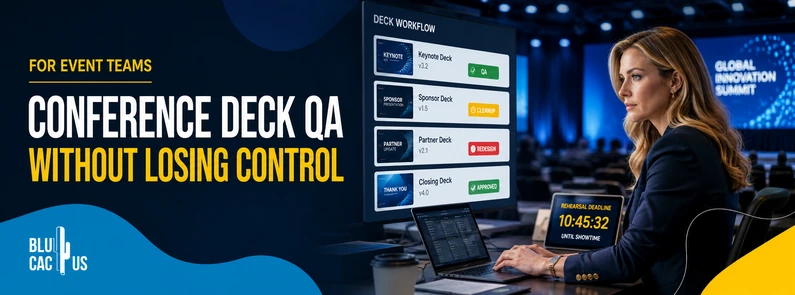
When dozens or hundreds of speaker files begin arriving close to a fixed event date, conference deck QA becomes an operational safeguard, not simply a final proofreading step. Every late upload, off-template slide, missing font, broken chart, embedded video, and unclear approval can affect rehearsal, production, or the live presentation.
Before outsourcing, event teams should define expected deck volume and timing, template and brand rules, QA depth, escalation categories, version ownership, approval authority, confidentiality requirements, and final delivery deadlines. An outside presentation partner needs a controlled workflow, not only access to a folder of speaker files.
A strong outsourcing plan adds capacity without taking control away from the event team. It also separates basic checks from cleanup, redesign, content approval, and production decisions.
What Does Conference Deck QA Actually Include?
Conference presentation QA can cover several different kinds of work. The event team should define the included checks instead of assuming that every file receives the same treatment.
Technical checks can include slide size, file format, links, hidden slides, embedded media, animations, compatibility, PDF exports, and filenames. Brand checks may cover fonts, logos, colors, title styles, footers, slide numbers, and event details.
Visual review may cover spacing, alignment, image quality, chart readability, text overflow, and consistency. Larger problems may require PowerPoint redesign for complex or off-template slides. New diagrams, major text reduction, or keynote development require separate scope.
Most importantly, presentation QA does not automatically verify the truth, legality, financial accuracy, scientific validity, or regulatory compliance of speaker content. Those responsibilities should remain with the speaker, event team, legal team, finance team, technical reviewer, medical reviewer, or another named subject-matter owner.
Why Event Teams Outsource Speaker Deck QA
Event teams usually outsource when the workload exceeds internal capacity. Submissions arrive in waves, quality varies, and internal designers may need to protect time for keynotes, executive sessions, or production assets.
Well-scoped conference deck QA services can add intake, triage, standardization, cleanup, coordination, and final review capacity. BluCactus treats conference presentations as an operating system. Depending on scope, conference presentation design support may separate high-volume speaker QA from keynote and executive work.
Still, outsourcing only helps when standards remain controlled. Without clear rules, an additional partner can create more questions, more versions, and more approval traffic. The event team should therefore establish the workflow before the first large submission wave arrives.
Conference Deck QA, Cleanup, or Redesign?
One of the most important scoping decisions is determining how deeply each deck may be changed. A three-level framework prevents minor QA from quietly expanding into full redesign work.
Swipe horizontally to view the full table on mobile.
| Service level | Typical work | Approval needed | Main timing risk |
|---|---|---|---|
| QA and compliance | Template, fonts, logos, formatting, links, media, naming, and export checks | Usually limited when standards are clear | Hidden technical issues or missing assets |
| Cleanup and standardization | Layout correction, spacing, typography, chart consistency, and off-template slide cleanup | Moderate, especially when the speaker’s layout changes | Scope expanding across many decks |
| Redesign or escalation | New layouts, diagrams, chart rebuilding, content restructuring, or keynote-level work | Explicit authorization before production continues | Additional design and review time |
The quote should state how many decks or slides are expected at each level, what triggers escalation, and who can authorize extra work. That distinction protects both the event schedule and the presentation budget.
Build a Controlled Workflow Before Speaker Files Arrive
A high-volume conference presentation workflow needs a repeatable path from submission to final delivery. Three controls matter most: deck triage, centralized intake, and one presentation standard.
Create a practical deck-triage system
Not every deck should enter the same queue. Event teams can use a simple Green, Yellow, Red, and Hold framework, although the labels are optional.
- Green: The correct template is in place, and the deck needs minor QA.
- Yellow: The file needs cleanup, standardization, or limited visual repair.
- Red: The deck requires major technical repair, redesign, missing content, or stakeholder escalation.
- Hold: Work cannot proceed because required files, approvals, fonts, data, media, or speaker information are missing.
Useful triage criteria include slide size, off-template slides, missing fonts, broken charts, image quality, text density, confidential content, media, and major content changes. “Make it look better” is not an operational standard.
Give deck intake one owner
Speaker files should enter through one controlled portal, folder, form, or email process. Each submission needs the speaker, session, contact, file type, source files, and approval status.
Files scattered across email, chat, and multiple folders increase version risk. One intake owner should control where files arrive, how they are named, and when they enter QA.
Create one conference presentation standard
The event team should provide more than a template. The standard may include dimensions, fonts, colors, logos, speaker and session formatting, charts, footers, slide numbers, disclaimers, accessibility, media, and prohibited changes.
Approved and unacceptable examples resolve questions faster than guidelines alone. When reusable layouts or usage rules are weak, a corporate presentation template system may need repair before submissions begin.
Build a Timeline That Protects Rehearsal and Production
The speaker submission deadline cannot be the same as the production deadline. The schedule needs room for review, escalation, correction, approval, rehearsal preparation, and final delivery.
Swipe horizontally to view the full table on mobile.
| Stage | Owner | Required output | Deadline relationship |
|---|---|---|---|
| Initial submission | Speaker or session owner | Editable source deck and required assets | Before QA begins |
| First QA review | Presentation partner | Issue classification and required actions | Before redesign or exception approval |
| Correction and escalation | Speaker and event owner | Resolved issues or authorized changes | Before final review |
| Internal approval | Event decision-maker | Approved presentation version | Before production handoff |
| Rehearsal-ready delivery | Production owner | Tested presentation file and backup format | Protected buffer before rehearsal |
| Final event version | Authorized file owner | Locked or approved final file | Before show time |
No universal number of days fits every event. Timing depends on deck volume, average slide count, review depth, source-file quality, approval speed, media testing, production requirements, and availability. The BluCactus guide to presentation redesign timeline factors explains why deeper changes require more time than basic cleanup.
Conference Deck QA Planning
Need to know whether your event workflow is ready to outsource?
Share the event date, estimated deck volume, submission schedule, template, QA standards, and escalation needs. BluCactus can review the workflow and identify the scope required.
Request a Conference Deck QA Review
Clear scope first. We review the volume, standards, and deadline before recommending a path.
Plan for Late Submissions and Parallel Production
Late files are common enough to plan for, but they cannot receive every optional improvement without affecting the wider schedule.
Set a cutoff, define post-cutoff support, and state when redesign is no longer practical. Late decks may receive priority checks for legibility, speaker details, media, technical behavior, and critical brand issues. Name who can authorize exceptions.
Parallel production helps when volume is high and QA, cleanup, and redesign use separate queues. Risks include inconsistent interpretation, duplicated work, naming conflicts, and uneven quality.
A potential partner should explain team roles, work allocation, design governance, QA ownership, and how consistency is maintained across reviewers and time zones. The answer matters more than a generic promise about team size.
Control Versions, Approvals, and Escalations
Version control should identify the current file, owner, status, and approval history. Naming could follow Event_Session_Speaker_V03_QAReview or Event_Session_Speaker_FINAL_APPROVED. Consistency matters more than the exact convention.
Use one source-of-truth location, visible statuses, version numbers, named owners, and change logs for critical files. Post-QA edits should re-enter review. Production should receive only the authorized version.
Escalation rules should identify issues that require approval before work continues. Common triggers include missing or conflicting content, major slide-count increases, custom diagram requests, new animation, data visualization without source data, corrupted files, missing fonts, broken media, confidential content, or work that exceeds the approved QA level.
For each trigger, define notification, documentation, approval, deadline impact, and whether the file returns to the speaker. Uncontrolled escalation can consume capacity reserved for other decks.
Separate Template Compliance From Content Accuracy
A presentation partner can review visual consistency, template compliance, speaker labels, obvious typos, formatting, chart readability, media, and technical behavior. That review does not replace subject-matter approval.
The speaker, event team, legal counsel, finance team, medical reviewer, scientific reviewer, technical owner, or another authorized stakeholder may still need to approve factual claims, financial figures, legal language, regulatory statements, scientific conclusions, customer data, product promises, and confidential information.
Scope language should identify who owns content accuracy and what happens when a reviewer notices a possible issue. A design team can flag an inconsistency without claiming authority to validate the underlying statement.
Protect Confidential and Restricted Event Content
Classify sensitive decks before files leave the internal environment. Restricted content may include financial data, customer information, unreleased products, legal material, or executive communication.
Confirm NDA terms, permissions, restricted folders, extended-team access, portfolio rules, transfers, and retention requirements. BluCactus can use an NDA-friendly process when access rules are confirmed in scope. No outside workflow is completely risk-free.
Font substitution can change line breaks, spacing, and layout. Microsoft explains the benefits and limitations of embedding custom fonts. Its Compatibility Checker guidance can support testing across PowerPoint versions or formats.
Enterprise Presentation Experience
Experience with enterprise-scale deck review
BluCactus supported a major global enterprise conference by designing a keynote presentation and completing review and QA checks across 168 speaker decks under a tight deadline. That experience informs how we approach intake, triage, template compliance, escalation, coordination, and final delivery.
Every event has a different volume, timeline, template, and production workflow. Current capacity and feasibility must be confirmed before scope approval. Review our presentation design proof and enterprise workflow.
What Should the Final Conference Deck QA Checklist Cover?
The final checklist should match the approved scope, but most event teams need to verify five areas.
- Presentation identity: Correct speaker, session title, event name, date, and approved template.
- Visual consistency: Fonts, colors, logos, spacing, alignment, titles, section dividers, charts, images, and readable footnotes.
- Technical behavior: Slide size, hyperlinks, video, audio, transitions, animations, compatibility, and backup format.
- File control: Correct filename, version, folder, export, owner, status, and approval record.
- Event readiness: Rehearsal version, production handoff, speaker confirmation when required, and authorized final file.
This checklist can flag visible or technical presentation problems. It does not replace factual, legal, financial, scientific, medical, or regulatory review unless the agreement explicitly assigns qualified reviewers to that responsibility.
Questions to Ask a Conference Deck QA Partner
A strong vendor review should evaluate operations, not only portfolio appearance. Ask:
- Have you handled high-volume presentation review before?
- How do you distinguish QA, cleanup, and redesign?
- What triage method will you use for incoming decks?
- Who manages intake, status tracking, and version ownership?
- How do you maintain consistency across multiple reviewers?
- Which template, brand, font, and source files do you need?
- How are late or incomplete submissions handled?
- Which issues trigger escalation, and who approves extra work?
- Can keynote and executive decks use a separate workflow?
- How are confidential or restricted files handled?
- Who performs the final QA review?
- What happens when data, fonts, approvals, or media are missing?
- Which editable, PDF, backup, or production-ready formats will be returned?
- What assumptions does the quote make about volume, slide count, and review depth?
- Is capacity confirmed for the event dates, and what work is excluded?
Specific answers reveal whether the partner can protect the workflow when submission patterns change.
What to Send Before Requesting a Conference Deck QA Proposal
A proposal brief should include event and rehearsal dates, time zone, estimated speakers and decks, slide ranges, submission waves, template, brand rules, file formats, QA standards, escalation levels, keynote needs, confidentiality, decision-makers, approval windows, folders, production handoff, and contingencies.
A conference proposal needs more operating detail than a normal one-deck request. The guide on how to prepare files for an outsourced presentation project covers the core handoff materials, while the conference brief adds volume, triage, governance, and production information.
State which counts, slide ranges, dates, or content conditions remain estimates. Transparent ranges support a better capacity and pricing discussion.
Presentation Design Support Across Major U.S. Event Markets
BluCactus is a Dallas-based agency serving businesses across the United States through remote presentation support. Conference presentation design can include keynote development, template systems, speaker-deck cleanup, and QA, depending on the event scope. Across the country, event and corporate teams can explore presentation design support for New York event and corporate teams, Los Angeles conferences and business events, Chicago enterprise communication, and Houston corporate and industry events. Regardless of location, the operational requirements remain the same: controlled intake, clear standards, version ownership, escalation rules, and protected production deadlines.
When Is Outsourcing Conference Deck QA the Right Decision?
Outsourcing may help when volume exceeds capacity, files arrive in waves, template compliance is critical, or internal designers must protect keynote work. It can also add one intake process, QA standard, and visible status tracking.
Outside support may be unnecessary when there are few decks, submissions arrive early, the template is simple, and internal capacity is sufficient. Balance coordination cost against added capacity.
The strongest case for outsourcing appears when the fixed event deadline and presentation workload create operational risk that the internal team cannot safely absorb.
Outsource the Workflow, Not the Event Team’s Control
An outside partner can manage intake, triage, cleanup, QA, escalation, standardization, and final file preparation when included in scope. The event team should retain authority over standards, content, speaker communication, approvals, and production.
A good relationship clarifies responsibility rather than transferring every decision. The event team gains capacity while keeping ownership of the event, message, and deadline.
Enterprise Presentation Support
Add deck capacity without losing control of the event workflow
Share the event timeline, estimated speaker-deck volume, keynote requirements, template, submission process, and production deadlines. BluCactus can assess the QA, cleanup, redesign, project-management, and delivery support your event may require.
Review My Event Presentation Workflow
No generic volume promise. First, we confirm the scope and capacity.
Frequently Asked Questions About Conference Deck QA
What is included in conference deck QA?
Conference deck QA may include template, fonts, logos, spacing, speaker details, links, media, slide size, filenames, exports, and version checks. Document the list because cleanup, redesign, narrative work, and content validation may require separate scope.
What is the difference between deck QA and presentation redesign?
QA checks defined visual, technical, and delivery standards. Cleanup corrects moderate layout problems. Redesign changes the structure or visual system through rebuilt charts, custom layouts, diagrams, text reduction, or keynote work.
How early should speakers submit presentations before a conference?
The deadline should leave time for QA, escalation, corrections, approval, production handoff, and rehearsal. Timing depends on volume, review depth, source files, media, approvals, production, and current capacity.
Can an agency review dozens or hundreds of speaker decks?
Potentially, but volume alone does not determine feasibility. Slide ranges, submission waves, template consistency, QA depth, approvals, production needs, and current availability determine whether capacity can be confirmed.
How should late speaker submissions be handled?
Define a cutoff and post-cutoff support. Late files may receive priority technical and compliance checks before optional refinements. Name who can authorize exceptions or limited cleanup.
Who checks the factual accuracy of speaker content?
A named speaker, event owner, legal, finance, medical, scientific, or technical reviewer should retain factual approval unless scope assigns it to a qualified reviewer. Design QA does not validate underlying claims by default.
Can confidential conference decks be reviewed under an NDA?
Yes. An NDA-friendly workflow can define access, restricted content, extended-team permissions, transfers, portfolio rules, and retention. No process should be described as completely risk-free.
What should an event team send before requesting a proposal?
Send event and rehearsal dates, time zone, deck volume, slide ranges, submission schedule, template, brand rules, QA standard, escalations, keynote needs, confidentiality, decision-makers, approval windows, production handoff, and contingencies.





Leave a Reply
Want to join the discussion?Feel free to contribute!